
Quick Teacher Guide: General-Audience Floor Adaptation Policy
In general preschool classroom settings, activities originating from historical trampoline examples are conducted on flat padded tumbling mats or carpeted floors rather than on elastic rebound equipment.
Coach children to land with two feet together and knees softly bent like a spring to absorb impact quietly and maintain balance.
Keep each child on their own designated floor spot. Multi-child hand-holding during jumping and elastic surface co-use are strictly prohibited.
Establish an immediate stop cue (such as 'Statue freeze!') so children learn to absorb kinetic energy and come to a balanced, controlled stand on demand.
10 Floor-Level Movement Adaptations
Step-by-step illustrated activities adapting historical trampoline concepts into safe floor-level stepping, supported takeoffs, clapping rhythm, and statue freeze stops.

Teacher-Supported Floor Jump & Stick
The child stands on a firm, non-slip padded floor while the teacher stands beside them offering gentle hand balance support as the child practices a small two-foot takeoff and quiet soft-knee landing.
Teacher Notes: Setup, Safety & Variations

Teacher-Modeled Floor Bounce Rhythm
The teacher stands on a firm floor spot facing the child, demonstrating a steady vertical knee-dip and bounce rhythm while the child mirrors the movement on their own floor spot without elastic apparatus.
Teacher Notes: Setup, Safety & Variations

Call-and-Response Floor Jump Rhythm
The teacher leads a rhythmic call-and-response count from the floor while the child executes individual two-foot takeoffs and soft-knee landings across designated floor markers.
Teacher Notes: Setup, Safety & Variations

Stable-Support Marching
The child grasps a stable program-approved support (such as a wall barre, ballet rail, or adult hands) and practices marching in place with alternating high knees on a non-slip floor.
Teacher Notes: Setup, Safety & Variations

Supported Two-Foot Floor Jumps
Holding a secure wall rail or adult hands with both hands, the child performs small, controlled two-foot vertical jumps on a flat tumbling mat, focusing on soft-knee cushioning.
Teacher Notes: Setup, Safety & Variations

Clap Jump & Stick-the-Landing
The child performs a small vertical two-foot jump on a flat floor mat, claps hands together at chest level, and lands with feet anchored in an immediate, quiet freeze.
Teacher Notes: Setup, Safety & Variations

Partner Rhythm Jump Spots
Two children stand on separate floor spots facing each other and practice matching their two-foot jump and landing rhythm without holding hands.
Teacher Notes: Setup, Safety & Variations

Turn-Then-Jump Direction Game
The child stands on a flat floor mat, pivots feet while standing to face a new target cone, pauses to verify balance, then executes a straight vertical jump.
Teacher Notes: Setup, Safety & Variations

Arm-Shape Jump Variations
Children explore creative arm shapes (airplane wings, hands on hips, reach for the stars) during small two-foot floor jumps while maintaining symmetrical foot placement under hips.
Teacher Notes: Setup, Safety & Variations

Low Jump & Statue Freeze
Children practice 2–3 small, consistent low-amplitude jumps on a flat tumbling mat and respond immediately to an auditory or visual stop cue by absorbing energy into a balanced statue freeze.
Teacher Notes: Setup, Safety & Variations
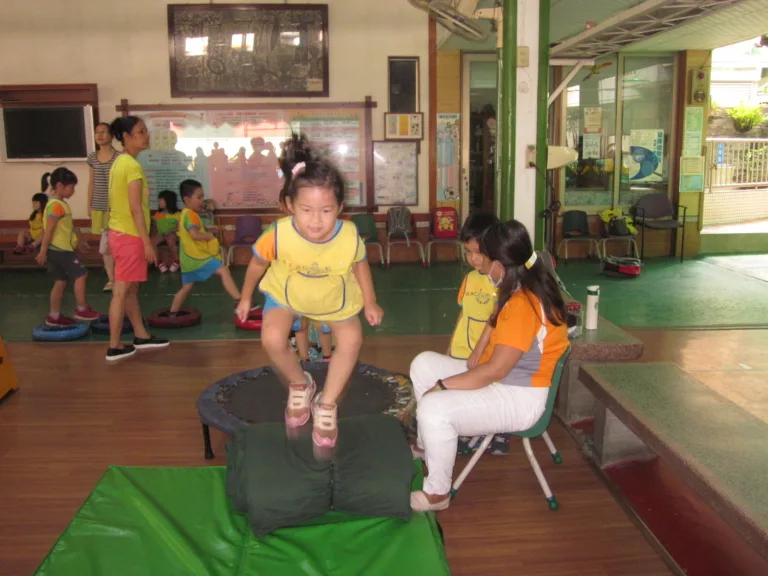
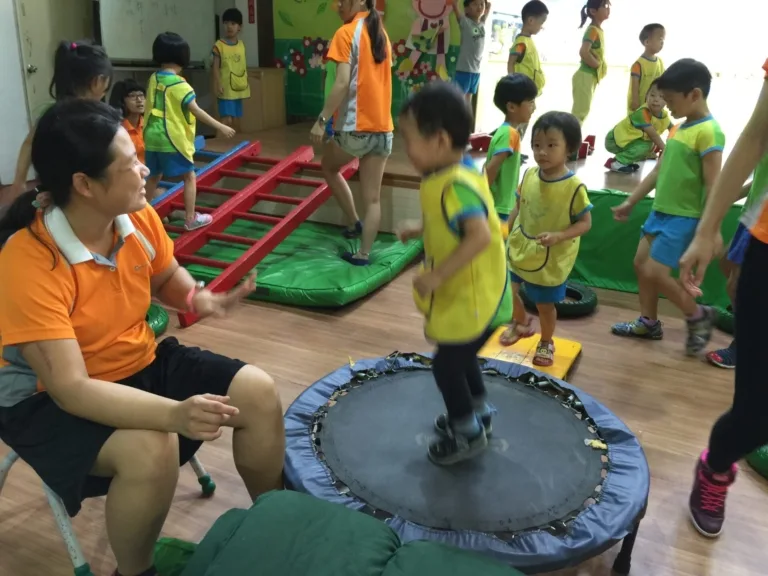
Historical Classroom Practice Records
Archival photos documenting prior classroom exploration at Jenher Preschool. These images are preserved for historical context and provenance, and are not the instructional model for the current general-audience floor adaptation.
Preschool Movement & Floor Jumping FAQ
Guidance on the general-audience floor-level adaptation policy, safe landing mechanics, and early learning development framework connections.
Is this page recommending trampoline apparatus use for preschool classrooms?
How do teachers coach children who are hesitant or learning two-foot takeoffs?
Why are mid-air rotational twists and flight gymnastics avoided?
What equipment is used for these general-audience floor adaptations?
How do these jumping activities relate to early learning development frameworks (such as Head Start ELOF)?
Try Next
Ch. 11 & 26 Gymnastics Mat (37 Activities)
Tumbling progressions, pencil rolls, forward rolls, and relay crawls.
Ch. 22 Obstacle Course Circuit (14 Stations)
Continuous station routes combining beams, mats, hops, and crawls.
Ch. 5 Jump Rope Games (44 Activities)
Progressive hopping, floor bounds, snake waves, and single jumps.

About 500 Preschool Movement Games
This curriculum originated from Nanhai Hong's years of practical early childhood physical education teaching. Jenher Preschool preserved the core activities, digitizing and updating the text, instructions, and safety guidelines for modern early childhood classroom needs.
This material is freely provided for classroom teaching and non-commercial research. When citing, please attribute "500 Preschool Movement Games" with a link to this webpage. Commercial resale or unauthorized mass reproduction is strictly prohibited.
Before starting, assess each child's readiness and ensure an open, slip-resistant play area with continuous adult supervision. For children with specific health, motor, or developmental considerations, please consult a pediatrician or pediatric physical therapist.