ECE Movement Curriculum · Chapter 11 & 26 Guide

15 Gymnastics Mat Activities for Preschoolers: Rolling, Crawling & Group Play

Develop whole-body flexibility, vestibular rolling mechanics, rolling control, body awareness, and cooperative group teamwork across 15 illustrated preschool gymnastics mat games and safety progressions.

ADVERTISEMENT

Quick Teacher Guide: Mat Safety, Spotting & Progression

Cervical Protection & Chin Tuck Rule

Strictly enforce the 'Tuck chin, eyes look at belly button' cue for all forward rolls. The crown (top) of the head must NEVER take vertical weight or direct mat impact.

Trained Spotter & Program Policy

Forward-roll spotting and incline-roll progressions should only be used where program policy permits and by an educator or movement specialist trained in the facility's approved spotting procedure. When trained spotting is unavailable, use non-inversion alternatives such as pencil rolls, rocking, crawling, or floor-level balance play.

Soft Obstacles & Never Use Human Mats

Always use high-density foam wedge blocks or soft bolsters for obstacle rolls. Never allow children to roll across or land on other children.

Low Waist-Height Team Mat Carrying

When practicing cooperative mat carrying (Activity 26-4), mats must be transported at low waist level with slow, matched footsteps. Never transport children on mats.

Chapter 11 Blueprint · 10 Illustrated Activities

Forward Rolls & Postural Control

Step-by-step rolling progressions from straight-body pencil rolls and bear-crawl entries to incline rolls, synchronized partner rolls, and penguin flippers.

Activity 11-1: Straight-Body Pencil Roll

Straight-Body Pencil Roll

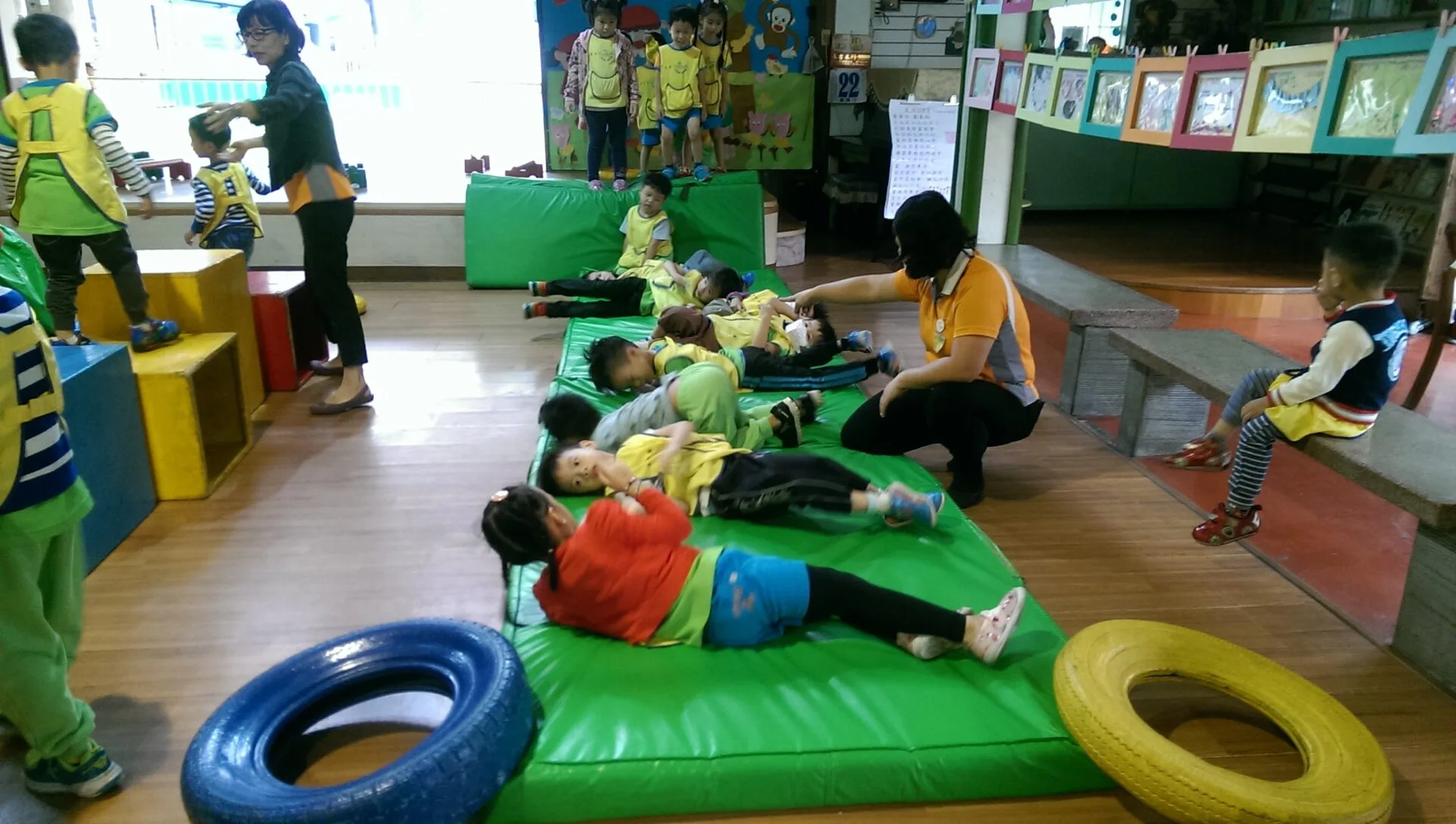
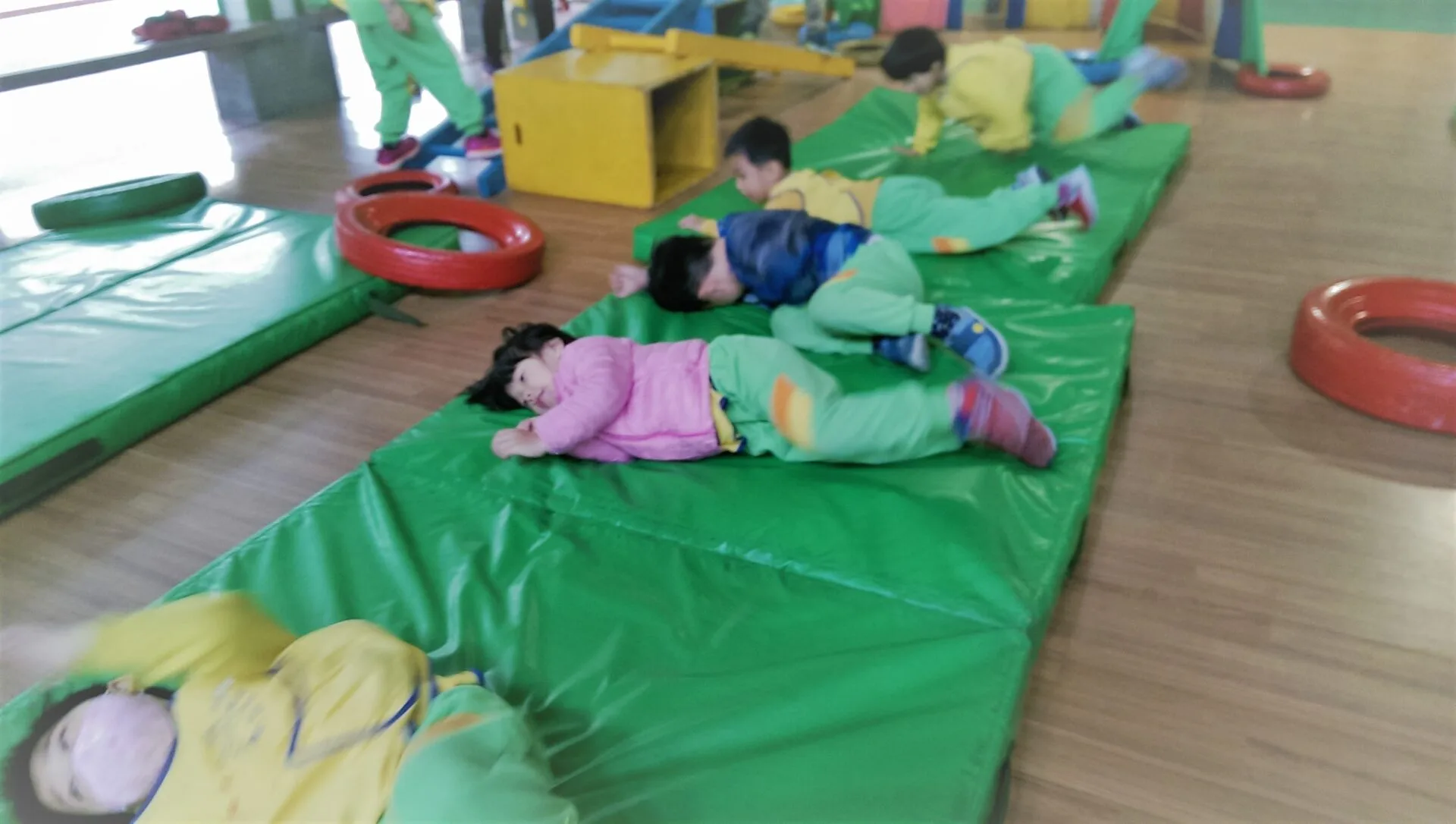
Lying flat on the mat with arms extended straight overhead like a pencil, the child rotates smoothly along their longitudinal body axis from back to tummy.

Teacher Notes: Setup, Safety & Variations
Equipment: Standard preschool tumbling mat (1.5–2 inch thickness)
Setup: Flat floor with clear boundaries so child rolls in a straight pathway.
Safety: Ensure arms stay beside ears to protect shoulders during rolling.
Make It Easier: Perform half-rolls from tummy to back before attempting full continuous rolls.
Make It Harder: Roll along a marked narrow tape lane without drifting off the mat edge.
Teacher Cue: "Straight like a pencil, tight like a log, roll smooth across the mat!"
Activity 11-2: Partner Synchronized Side Roll

Partner Synchronized Side Roll

Two children roll independently in parallel designated lanes side-by-side with matched rhythm, developing motor timing and peer cooperation.

Teacher Notes: Setup, Safety & Variations
Equipment: 2 parallel tumbling mats providing separate rolling lanes
Setup: Dedicated partner lane free of other moving children.
Safety: Modern safety adaptation: Children roll in separate, parallel mat lanes rather than embracing or holding onto each other mid-roll. Pair children of similar readiness and instruct them to tuck chins and roll at a gentle, matched pace.
Make It Easier: Practice gentle rock-and-roll side sways in place before completing full revolutions.
Make It Harder: Count '1-2-3-Roll!' and complete 2–3 consecutive smooth revolutions in parallel lanes.
Teacher Cue: "Roll in your own lane, match your friend's rhythm, and roll smooth like twin wheels!"
Activity 11-3: Foam Obstacle Roll-Over

Foam Obstacle Roll-Over

Children roll safely across a soft foam roller or cushioned wedge obstacle on the mat, practicing dynamic weight-transfer and tactile navigation.

Teacher Notes: Setup, Safety & Variations
Equipment: 1 soft foam cylinder / wedge bolster placed on a thick gymnastics mat
Setup: Spacious station with teacher spotting alongside the obstacle.
Safety: Modern Safety Adaptation: Always use soft foam bolsters or folded cushions as obstacles—never use other children as landing or rolling surfaces.
Make It Easier: Crawl hands and knees over the foam bolster before attempting rolling.
Make It Harder: Perform a smooth pencil roll across the contoured foam bolster without rolling off the mat.
Teacher Cue: "Hands reaching long, roll gently over the soft hill like a rolling river!"
Activity 11-4: Four-Point Bear Crawl Forward Roll

Four-Point Bear Crawl Forward Roll

Starting from a four-point bear crawl stance with hips elevated, the child tucks their chin tightly toward their belly button and allows momentum to roll onto the upper back.

Teacher Notes: Setup, Safety & Variations
Equipment: 2-inch thick high-density folding tumbling mat
Setup: One child on the mat at a time with a dedicated teacher or spotter kneeling beside.
Safety: Strictly enforce 'Tuck chin, eyes look at belly button'. The top of the head must NEVER take direct vertical weight or impact. Requires demonstrated child readiness and supportive hands on mat. Stop immediately if the child hesitates or loses hand placement.
Make It Easier: Practice rock-to-back cradle in seated position before the full roll.
Make It Harder: Transition smoothly from the roll into a balanced seated or kneeling pose.
Teacher Cue: "Bear walks forward, tuck your chin like a turtle, look at your tummy, and roll!"
Activity 11-5: Supported Frog-Squat Roll Entry

Supported Frog-Squat Roll Entry

Beginning in a deep frog squat with both hands planted firmly on the mat, the child shifts weight forward gradually, lifts the hips under control, and rolls onto the padded mat with chin tucked.

Teacher Notes: Setup, Safety & Variations
Equipment: High-density gym mat (wedge incline mat recommended for beginners)
Setup: Clear landing zone with safety perimeter.
Safety: Modern safety adaptation: Ensure hands remain firmly planted on the mat throughout entry; no airborne hops or jump takeoffs into rolls. Stop immediately if chin tuck is lost.
Make It Easier: Perform on an incline wedge mat with adult support so gravity naturally assists gentle hip elevation.
Make It Harder: Roll from a static squat entry and recover smoothly into a balanced kneeling or seated hold on the mat.
Teacher Cue: "Hands flat on the lily pad, shift forward gentle, tuck your chin, and roll like a ball!"
Activity 11-6: Slow-Motion Forward Roll Coaching

Slow-Motion Forward Roll Coaching

A teacher-assisted progression where the child slows down each phase of the forward roll—hand placement, chin tuck, hip lift, and upper-back contact—to master safe biomechanics.

Teacher Notes: Setup, Safety & Variations
Equipment: High-density tumbling mat with visual hand placement markers
Setup: Dedicated teaching station with teacher kneeling at side in stable athletic stance.
Safety: A trained spotter follows the program's approved procedure, placing one hand behind the child's upper back/shoulders (zero direct neck pressure) and one hand behind thighs to guide rotation. Stop immediately if the child appears hesitant or fearful, loses chin tuck, places weight on the crown of the head, cannot maintain hand support, or reports discomfort.
Make It Easier: Hold the tucked cradle position on the mat while teacher rocks child gently.
Make It Harder: Child self-narrates the safety steps out loud while performing the slow-motion roll.
Teacher Cue: "Hands flat... chin to chest... lift hips high... roll onto your soft upper back!"
Activity 11-7: Incline Wedge Forward Roll

Incline Wedge Forward Roll

After establishing sound tumbling mechanics, the child uses a soft incline wedge mat to assist gentle forward hip elevation and a fluid roll.

Teacher Notes: Setup, Safety & Variations
Equipment: Gymnastics incline cheese/wedge mat positioned on heavy-duty safety pads
Setup: Strictly one-at-a-time with teacher spotting at all times.
Safety: Modern safety adaptation: Use only in a program that permits preschool tumbling progressions and with a trained spotter following demonstrated readiness. Stop immediately if the child cannot keep hands planted and chin tucked. General classrooms may use pencil rolls or incline crawling instead. Prohibit diving, jump takeoffs, or unspotted repetitions.
Make It Easier: Place hands on the incline wedge and rock forward with adult holding hips.
Make It Harder: Perform continuous smooth roll down the wedge recovering into a stable seated balance.
Teacher Cue: "Hands down soft, tuck chin deep to chest, and glide gently down the wedge!"
Activity 11-8: Partner Synchronized Forward Roll

Partner Synchronized Forward Roll

Two children stand side-by-side in separate mat lanes, count to three together, and execute matching forward rolls in synchronized harmony.

Teacher Notes: Setup, Safety & Variations
Equipment: 2 side-by-side tumbling mats firmly secured with velcro straps
Setup: Wide indoor tumbling area with clear lane spacing.
Safety: Safety Adaptation: Children roll side-by-side in separate space lanes rather than holding hands during mid-roll, allowing two hands flat on the mat for full support.
Make It Easier: One child rolls first while the partner watches and counts, then switch.
Make It Harder: Coordinate synchronized start counts and simultaneous balanced standing recoveries without holding hands.
Teacher Cue: "Ready, set, 1-2-3 tuck and roll together like twin wheels!"
Activity 11-9: Sequential Team Forward Roll Wave

Sequential Team Forward Roll Wave

Four children line up side-by-side in separate mat lanes and execute a coordinated rolling wave sequentially on teacher rhythm cues, building ensemble timing.

Teacher Notes: Setup, Safety & Variations
Equipment: 4 attached tumbling mats forming a broad safety zone
Setup: Spacious activity hall with open perimeter.
Safety: Enforce generous site-specific lane spacing between children (ensuring children cannot roll into neighboring pathways) and practice one child per lane.
Make It Easier: Perform sequential pencil rolls instead of forward rolls.
Make It Harder: Execute on a continuous 4-beat drum rhythm where each beat triggers the next child.
Teacher Cue: "Listen for your beat... 1, 2, 3, 4! Roll in a beautiful ocean wave!"
Activity 11-10: Curled-Ball Forward Roll

Curled-Ball Forward Roll

With hands positioned close to shoulders and chin tucked tightly, the child relies on rounded spinal curvature and gentle momentum to complete a smooth roll on a soft mat.

Teacher Notes: Setup, Safety & Variations
Equipment: Soft high-density tumbling mat (or wedge mat)
Setup: Teacher spotting required at all times.
Safety: Modern safety adaptation: Maintain hands in supportive contact near the mat/shoulders throughout the roll. Prohibit unsupported no-hands rolling, diving, or forced immediate jump-to-stand movements. Stop if chin tuck is compromised.
Make It Easier: Practice curled cradle rocking on the back before attempting the forward roll.
Make It Harder: Perform the roll smoothly with controlled chin tuck, maintaining rounded back and recovering into a stable seated balance.
Teacher Cue: "Tuck your chin tight, curve your back like a shell, and roll smoothly over!"
Chapter 26 Blueprint · 5 Illustrated Activities

Group Relays, Island Navigation & Mat Tag

Cooperative whole-class games including auditory body-part touch, dual-lane relay races, ocean island navigation, four-child mat carrying, and safe-haven tag.

Activity 26-1: Body-Part-to-Mat Contact Challenge

Body-Part-to-Mat Contact Challenge

Children jog around the activity room; when the teacher calls out a specific body part (elbow, knee, back, or tummy), children react calmly to place that exact part on a mat.

Teacher Notes: Setup, Safety & Variations
Equipment: 4–6 gymnastics mats spread across the gym floor
Setup: Wide gym or multi-purpose room with non-slip flooring.
Safety: Teach children to share mat space generously and avoid tackling or crowding onto single spots.
Make It Easier: Call out simple body parts (hands, feet) with generous transition time.
Make It Harder: Call combination commands (e.g., 'One elbow and one knee on the blue mat!').
Teacher Cue: "Walk around the room... FREEZE! Put your left elbow on a mat!"
Activity 26-2: Mat Relay Course

Mat Relay Course

Divided into small teams, children move along designated perimeter pathways around gymnastics mats, high-fiving teammates to pass the turn in a cooperative relay.

Teacher Notes: Setup, Safety & Variations
Equipment: 4 gymnastics mats arranged in parallel relay tracks · Floor lane tape
Setup: Unobstructed circular running lanes around the perimeter of mats.
Safety: Ensure generous site-specific run-off clearance from walls, doors, and equipment. For tight indoor spaces, use controlled walking or animal walks rather than sprinting.
Make It Easier: Steady walking pace instead of jogging; smaller group sizes (3 per team).
Make It Harder: Incorporate an animal walk (bear crawl or bunny hop) around the mat pathway.
Teacher Cue: "Move around the mat track, give your partner a high-five, and cheer for your team!"
Activity 26-3: Island Crossing Mat Adventure

Island Crossing Mat Adventure

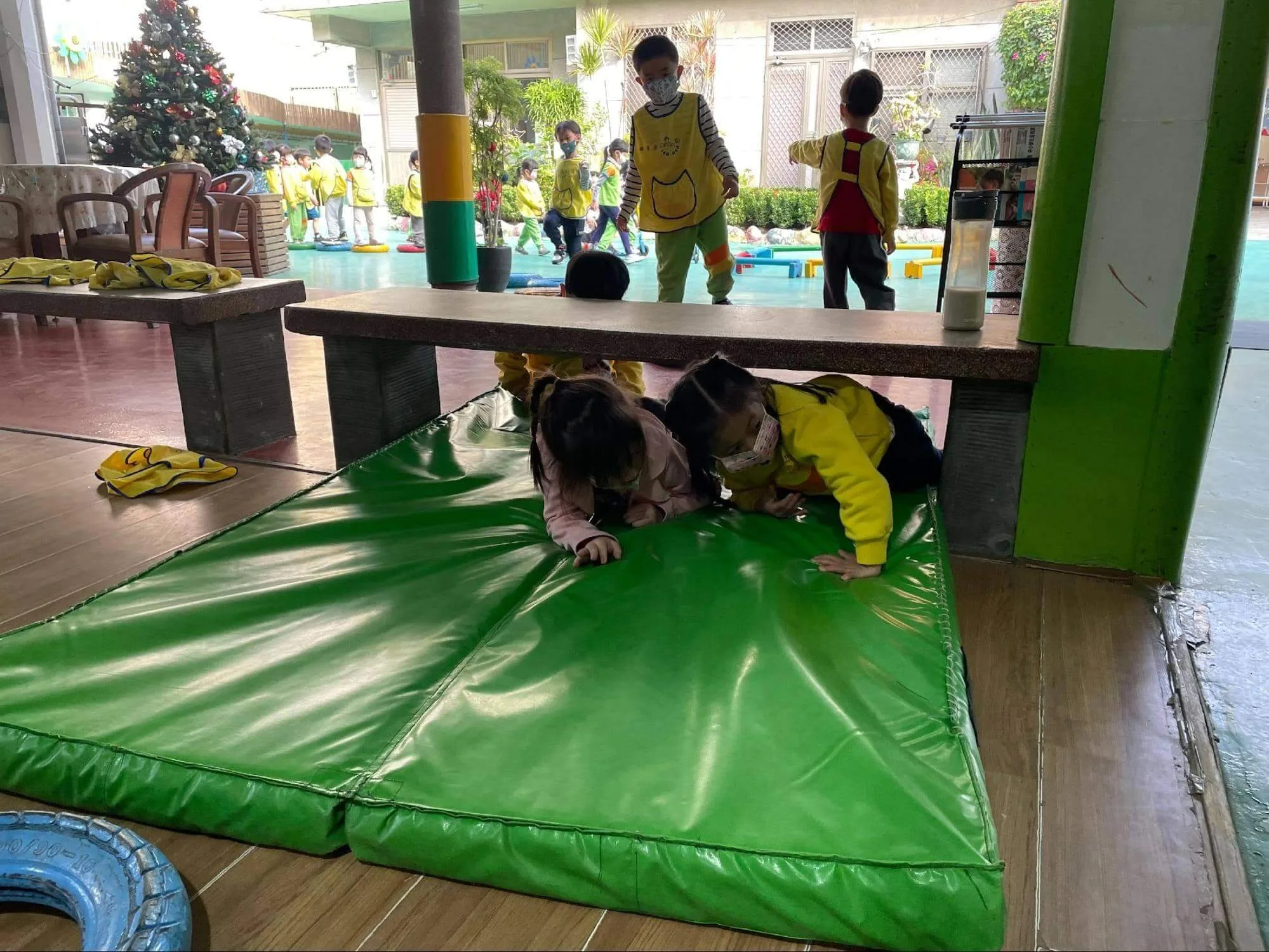
Gymnastics mats serve as safe 'islands' in a pretend ocean. Children navigate between islands by bear crawling, stepping over stepping stones, or swimming on their tummies.

Teacher Notes: Setup, Safety & Variations
Equipment: 3–5 gymnastics mats spaced 1.5–2 feet apart (adjusted for child stride length) · Foam balance pads / hoops
Setup: Open floor with clean spacing between island stations.
Safety: Keep inter-island gaps appropriate to age group (1.5–2 feet) to prevent over-reaching trips.
Make It Easier: Place mats touching edge-to-edge as a continuous safe walkway.
Make It Harder: Hop from island to island using a controlled two-foot takeoff and soft two-foot landing with bent knees.
Teacher Cue: "Don't fall in the pretend water! Step from island to island like a brave explorer!"
Activity 26-4: Four-Child Cooperative Mat Carry

Four-Child Cooperative Mat Carry

Four children grasp the four corners of a lightweight gymnastics mat, coordinating their walking tempo and communication to transport the mat safely across the gym floor.

Teacher Notes: Setup, Safety & Variations
Equipment: 1 lightweight preschool folding gym mat suitable for four-child cooperative carry
Setup: Wide open floor with clear destination drop zones.
Safety: Strict Safety Rules: Adults must assess mat weight, handles, group readiness, and transport route prior to activity. Carry at low waist height only; never carry children on mats; enforce slow, coordinated marching footsteps.
Make It Easier: Teacher holds one side to help balance weight for younger children.
Make It Harder: Navigate around cone slalom markers while maintaining smooth level mat carrying.
Teacher Cue: "Lift together on three: 1-2-3 lift! March together left, right, left, right!"
Activity 26-5: Mat Tag & Safe Haven

Mat Tag & Safe Haven

A cooperative tag and spatial game where gymnastics mats serve as temporary safe havens. Children practice controlled deceleration, spatial awareness, and calm transitions.

Teacher Notes: Setup, Safety & Variations
Equipment: 3–4 large non-slip gymnastics mats spread around the gym
Setup: Enclosed gymnasium or marked multi-purpose indoor area.
Safety: Modern safety adaptation: Enforce gentle two-finger butterfly tagging; encourage children to choose safe havens calmly with teacher-guided transitions to prevent overcrowding. Do not use emergency-braking drills, forced safe-haven time limits, or required rapid rolling as part of this game.
Make It Easier: Designate two taggers with soft pool noodles instead of hand tagging.
Make It Harder: Children pause on the mat in a balanced flamingo or tree pose before re-entering play.
Teacher Cue: "Move swift, step safe onto the island! Pause, breathe, and rejoin the fun!"
Frequently Asked Questions

Preschool Gymnastics Mat FAQ

Expert teacher guidance on hesitation coaching, teacher spotting mechanics, fall protection instincts, and Head Start ELOF alignment.

How do teachers help children who are hesitant or afraid to do a forward roll?
Begin with non-inversion movements such as the Straight-Body Pencil Roll (Activity 11-1) or gentle cradle rocking. Where program policy permits preschool tumbling and a trained spotter is available, an incline wedge mat may be introduced as a supported progression. Otherwise, continue with non-inversion rolling, crawling, rocking, and floor-level balance play.
Who should assist preschool forward-roll progressions?
Forward-roll spotting and tumbling progressions must only be guided by an educator or movement specialist trained in the facility's approved spotting procedure, with zero direct pressure on the neck. If trained spotting or approved program policy is unavailable, classrooms should focus on non-inversion alternatives such as pencil rolls, cradle rocks, and floor-level movement play.
How do gymnastics mat activities support developmental body awareness?
Mat activities can offer practice with body awareness, rolling control, safe landing shapes, and spatial orientation. These activities are not a substitute for formal gymnastics instruction or injury-prevention training.
What safety protocols should be enforced during team mat relays and tag games?
Ensure mats have non-slip rubberized backing or are secured to gym floors. In tag games, provide calm safe-haven transitions to prevent overcrowding, and require two-finger butterfly tags rather than pushing.
Which Head Start Early Learning Outcomes Framework (ELOF) domains do these activities support?
These activities offer opportunities to practice skills aligned with Perceptual, Motor, and Physical Development (specifically P-PMP 1: Gross motor control and coordination and P-PMP 2: Dynamic balance and perceptual-motor guidance), as well as Social and Emotional Development (P-SE 4: Cooperative teamwork).
ADVERTISEMENT

Try Next